Renovation
Kitchen renovation (reforma de cocina) in València
Swapping old units for new ones is one job. Moving the sink, the hob or the wiring is another, with its own paperwork. We tell you which yours is, and the whole kitchen goes into one fixed-price quote in writing.
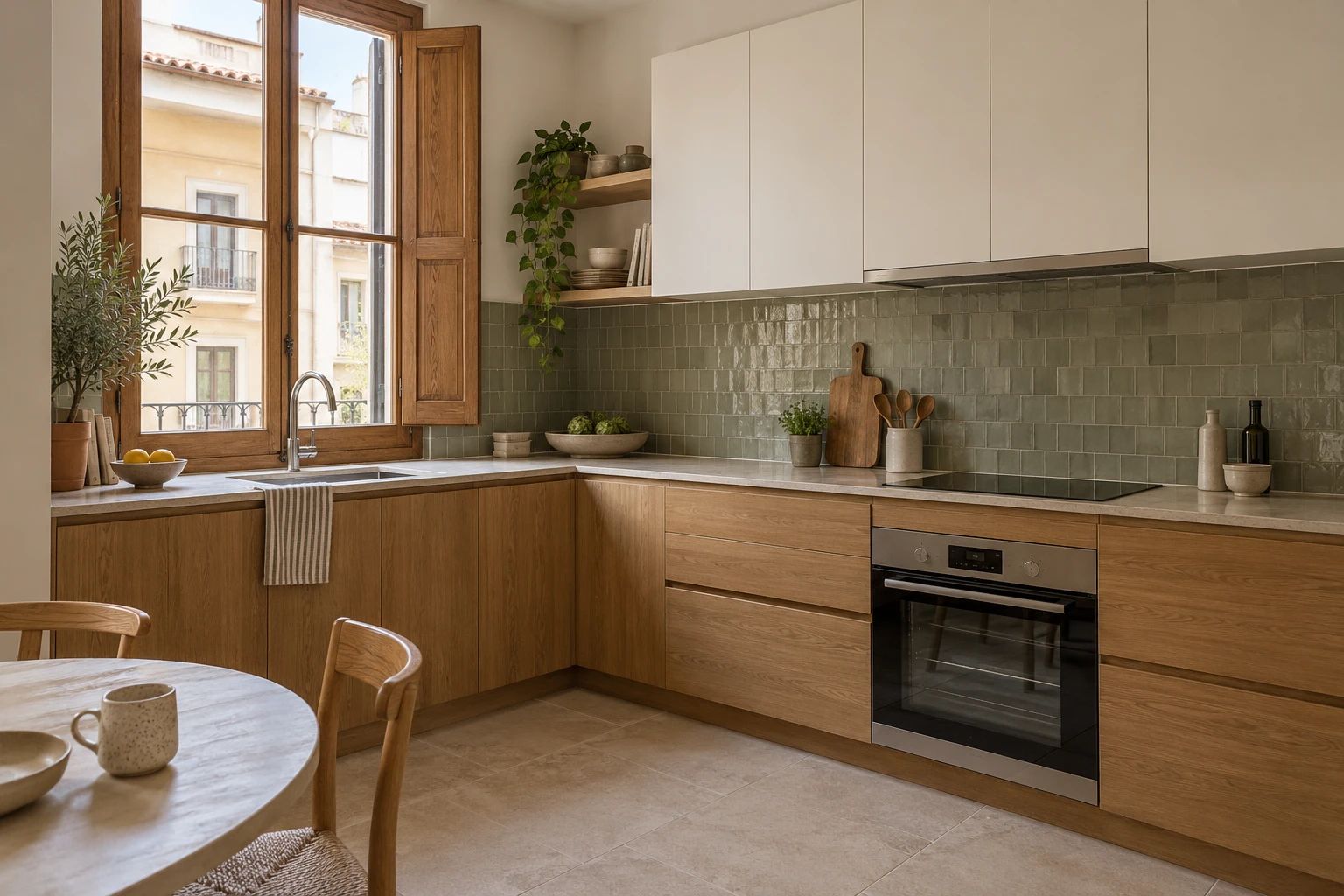
Kitchen renovation in València: how the rules apply
Each rule below comes from a municipal, regional or national text listed in the sources. The note says what it means for this job; open a rule to read its full wording.
Permission and paperwork
- Start on filing (art. 26)
Order the units to arrive after filing: the old kitchen comes out only when the declared work can lawfully start.[1]
Rule wording
A valid declaración responsable with all required documents enables the covered works to start on filing, subject to municipal checks. Filing is not a licence or confirmation that an unsuitable project is lawful.
- Notify start and end (art. 28)
The start notice follows the removal of the old kitchen; the completion notice follows the final installation checks.[1]
Rule wording
The start and completion of declared works must each be notified to the Ajuntament within 15 days of the event, with the documents required by article 28.
Official charges and tax
- ICIO 4%
Charged on the execution cost of the declared kitchen works, which is why the quote separates installation, units and appliances.[4, 3]
Rule wording
València’s ICIO rate is 4% of the taxable execution material cost. The declared budget, applicable exclusions and any relief must be checked for the particular works.
- Tasa from €140.90
The first band covers a declared base up to €6,010.12; a kitchen with new circuits, plumbing and extraction moves up the sliding scale.[5]
Rule wording
The planning fee (tasa urbanística) starts at €140.90 for a base of up to €6,010.12 and rises on a sliding scale. It uses the same base as ICIO.
- IVA 10%
Units, worktops and appliances we supply count as materials towards the 40% limit, so the quote shows the materials and labour split that decides the rate.[6, 7]
Rule wording
Ordinary dwelling renovation or repair can qualify for 10% IVA when the recipient is a private individual using the dwelling privately, construction or rehabilitation finished at least 2 years before the works, and contractor-supplied materials cost no more than 40% of the taxable base. Qualifying communities of owners are also covered by the law.
- IVA 21%
If the materials share passes the limit, or the flat is let, the kitchen is invoiced at the general rate unless the separate rehabilitation test applies.[6, 7, 8]
Rule wording
The general IVA rate for ordinary repair or renovation is 21%; the private-home reduced-rate route does not cover rented or business-use dwellings. Construction and works meeting the tax definition of rehabilitation have a separate reduced-rate test, so the contract must be assessed before assigning a rate.
Community and building
- Notice to the community (LPH 7.1)
Notice goes to the administrator before the old kitchen comes out; a new extraction outlet on the façade or into a shared shaft is a separate community question.[9]
Rule wording
An owner must notify the community’s representative before works inside a flat. Article 7.1 allows those alterations only if they do not impair the building’s safety, general structure or exterior configuration, or prejudice another owner’s rights; notice alone does not authorise changes to common elements.
- Three-fifths (LPH 17.4)
Running extraction through the façade or a shared shaft alters a common element, so the community decision is settled before the hood is chosen.[9]
Rule wording
Article 17.4 includes a three-fifths vote of all owners and participation quotas for specified structural or common-element alterations, including terrace enclosure, with affected owners’ consent where applicable. Compulsory works and other specific statutory routes must be considered separately.
On site and at handover
- Electrical installation documentation
New kitchen circuits are installed by an authorised electrical installer, verified and certified as the work requires; the documents and instructions go into your handover file.[11]
Rule wording
REBT requires low-voltage installation work within its scope to be carried out by authorised installation businesses, with the project or technical report, verification and certification appropriate to the work. The owner receives use and maintenance information; an inspection by a control body is required only for the specified cases.
- Gas work by an authorised installer
Moving a gas hob or boiler connection is work for an authorised gas installer, who tests the installation and issues its certificate; switching to induction removes the gas work but changes the electrical scope.[12]
Rule wording
Installing or modifying a gas receiving installation is the work of an authorised gas installation company, which carries out a leak test and issues the installation certificate (ITC-ICG 07 and 09). Mains-supplied installations are inspected every five years by an authorised installer or the distributor, at the user’s cost.
- Architect and technical roles
If knocking through brings the kitchen within the LOE's project requirements, the architect and technical architect roles are appointed before demolition.[10]
Rule wording
For residential building work within the LOE’s project requirements, the law assigns the architectural project and works direction to an architect, and material execution direction to a technical architect. Specialist designers and other technicians act within their legal competence and the agreed project team.
- Working hours (noise ordinance)
Tile removal and wall chasing are the loud days of a kitchen job; they are booked inside the ordinance's hours and announced to the building.[13]
Rule wording
València’s 2023 noise ordinance allows works in buildings that affect the public domain from 08:00 to 22:00, Monday to Saturday, and from 09:30 to 22:00 on Sundays and public holidays, with exceptions for urgent or authorised work (art. 31). Noisy domestic renovation is also banned at night: 22:00 to 08:00 from Sunday to Thursday, and 22:00 to 09:30 on Fridays, Saturdays and the eves of holidays (art. 30).
Do you need a permit?
València’s 2026 ordinance has three routes. Which one your job takes depends on what it touches and on the building.
No permit
New units, a new worktop and appliances in the existing positions can be exempt under article 14.f, as long as the sink, hob and sockets stay where they are and no pipe or circuit changes. [1]
Declaración responsable
Moving the sink to an island, adding a circuit for the hob or rerouting extraction changes the flat's installations; in a non-catalogued building the kitchen is then declared through UR.LC.140 with the documents that scope requires. [1, 2] [3] [3]
Licence
Opening the kitchen into the living room through a load-bearing wall needs a structural assessment first; where it replaces principal structural elements, or the building is catalogued, the route goes beyond a simple interior declaration. [3, 2] [1, 2]
The Ajuntament has the final word. We confirm the route for your home before we quote, and we never start works ahead of it.
Three districts, from the municipal record
The 2025 municipal housing sheet records the share of dwellings built in 1980 or earlier. It is context for the district, not a survey of your building.
District 2
84.6%[14]
Dwellings built in 1980 or earlier
L’Eixample (Ensanche)
Behind the El Pla del Remei façades, buildings such as Edificio Ferrer have their own catalogue entry [15]; before an extraction outlet or a new window goes on a façade, we check the block's record.
District 9
65.6%[16]
Dwellings built in 1980 or earlier
Jesús
Around two thirds of dwellings in Jesús are recorded as built by 1980; in a kitchen of that age, we trace where the shared waste stack and the supply pipes run before moving the sink.
District 13
66.6%[17]
Dwellings built in 1980 or earlier
Algirós
With a similar recorded age in L’Amistat, La Vega Baixa and Ciutat Jardí, an older flat's electrical supply may not suit an induction hob and an oven together; the installer checks the circuit and contracted power before appliances are chosen.
Open the district page for protection rules, barrios and the questions that apply there.
Compare layouts before choosing units
A straight run, an L-shaped arrangement and an island use space differently. Test circulation, door swings, appliance opening, worktop use and storage against measured dimensions. Keeping wet services close to existing connections may simplify the intervention; moving them requires assessment. The kitchen layout guide explains the choices.
The installations shape the scope
The exemption depends on the installations staying untouched. [1] A relocated sink or new circuit changes the job even if the finished room looks similar, and brings in the declaration’s technical documents. [3] Electrical work and its verification belong to the authorised installer. [11]
Before developing an open-plan kitchen, establish the wall’s structural role and any protected fabric or shared services. UR.LC.140 includes certain structural modifications that do not replace or reinstate principal structural elements. A competent technician must establish the intervention, documentation and correct permission route before demolition; a structural change is not automatically covered by a simple interior-works declaration.[3, 2] Extraction through a façade or shared shaft also needs assessment and the appropriate community decision. [9] Equipment selection follows the ventilation design; a recirculating hood is not automatically a substitute for required room ventilation.
Specify, install and check
The quote identifies cabinetry, worktops, appliances, lighting, plumbing and making good, including who supplies each item. We coordinate delivery and worktop templating with the room’s condition and agree when the old kitchen must come out. If you remain at home, plan the period without cooking or washing facilities.
Checks cover the relevant water connections and drainage, electrical work, extraction operation, appliance access, joinery adjustments and joints. Keep product instructions, applicable certificates and the outstanding-item record. The handover guide provides the checklist.
The supplied-materials test matters for ordinary renovation IVA. [6, 7] Tax treatment follows the actual contract, including a separate assessment where fiscal rehabilitation applies.
How we run it
Free estimate
Send photos or a short video, or book a call. We tell you what the job involves and give a free estimate.
Visit
We visit the property, measure up and look at the building, the installations and the community’s rules.
Design and permissions
We agree the design, coordinate any required independent architect or engineer, and check municipal and community requirements.
Fixed-price quote
You get a fixed-price quote in writing, with the official fees and IVA shown separately.
Paperwork and works
We coordinate any required filing and prior approvals before the affected works start. Your project manager tracks progress, decisions and agreed changes.
Handover
We inspect the agreed work with you, record outstanding items and hand over applicable certificates, manuals and completion documents.
Your questions, answered
Are new kitchen units without moving anything a no-permit job?
They can be. Replacing units and fitting appliances is on the article 14.f list when the work does not affect the flat's installations or the building's general installations. Move the sink or hob, add a circuit or change the extraction route and the kitchen needs the declaration and its documents instead.
Can I move the sink to an island?
Often, yes, but it stops being a no-permit job, because the sink needs new supply and waste pipes. In a flat the waste also has to reach the building's downpipe with enough fall, which we check on site before we design anything.
Can you knock the kitchen through into the living room?
Possibly. A competent professional establishes the wall's role before anything is designed; if it is structural, the opening needs a structural design, the right permission route and, in a block, the community decision. An open kitchen also changes how cooking smells and steam leave the home, so ventilation and extraction are designed with the opening.
Who should buy the appliances?
Either of us can. Appliances we supply count as materials in the 40% test for the 10% IVA route on ordinary renovation; appliances you buy yourself are outside our invoice. We show both options in the quote so you can see the effect before deciding.
How long will I be without a kitchen?
That depends on whether installations move and when the units arrive. Your quote sets out the order of work and the days the kitchen will be out of use, so you can plan around them.
Sources
- Ordenanza reguladora de licencias urbanísticas y de actividades y de otros títulos habilitantes (Pleno 22 Dec 2025, BOP 27 Jan 2026, in force 28 Jan 2026). Ajuntament de València. Checked 31 October 2026.
- TRLOTUP (Decreto Legislativo 1/2021), art. 189: building evaluation; arts. 232 and 233: licence and declaración responsable; art. 245: utility supplies. Generalitat Valenciana (DOGV). Checked 3 November 2026.
- Sede electrónica procedure UR.LC.140: declaración responsable for works in a flat or common element of a non-catalogued building. Ajuntament de València, sede electrónica. Checked 31 October 2026.
- Ordenanza fiscal reguladora del Impuesto sobre Construcciones, Instalaciones y Obras, arts. 6.2 (bonuses), 7, 8 and 9.2. Ajuntament de València. Checked 3 November 2026.
- Ordenanza fiscal: tasa por actuaciones urbanísticas (current municipal procedure attachment). Ajuntament de València. Checked 31 October 2026.
- Ley 37/1992 del IVA, art. 91.Uno.2.10º: reduced rate for renovation of dwellings. BOE. Checked 31 October 2026.
- IVA on renovation and repair works in dwellings: conditions for the 10% rate. Agencia Tributaria (AEAT). Checked 31 October 2026.
- IVA: works of construction or rehabilitation of buildings intended mainly for dwellings. Agencia Tributaria (AEAT). Checked 31 October 2026.
- Ley 49/1960 de Propiedad Horizontal (consolidated text), arts. 7, 9, 10 and 17. BOE. Checked 3 November 2026.
- Ley 38/1999 de Ordenación de la Edificación: arts. 2, 6, 7, 10, 12 and 13. BOE. Checked 31 October 2026.
- Real Decreto 842/2002: Reglamento electrotécnico para baja tensión, arts. 18–20. BOE. Checked 31 October 2026.
- Real Decreto 919/2006: gaseous fuels regulation, art. 8, ITC-ICG 07 and ITC-ICG 09. BOE. Checked 3 November 2026.
- Ordenanza municipal de protección contra la contaminación acústica (BOP 16 May 2023, in force 17 May 2023; consolidated with the 2025 amendments), arts. 30 and 31. Ajuntament de València. Checked 3 November 2026.
- Municipal district 2 report 2025: population sections 1.3/1.8 and cadastral housing age section 5.1 (page 19). Ajuntament de València, Oficina de Estadística. Checked 31 October 2026.
- Municipal structural heritage catalogue: 02-05 Edificio Ferrer. Ajuntament de València, Urbanisme. Checked 31 October 2026.
- Municipal district 9 report 2025: population sections 1.3/1.8 and cadastral housing age section 5.1 (page 19). Ajuntament de València, Oficina de Estadística. Checked 31 October 2026.
- Municipal district 13 report 2025: population sections 1.3/1.8 and cadastral housing age section 5.1 (page 19). Ajuntament de València, Oficina de Estadística. Checked 31 October 2026.